
Watch: A personal introduction to this course from Taylor, course facilitator and founder of Everyday Peacebuilding
This is a self-guided virtual eCourse, accessible on desktop or on your mobile phone via the Teachable app.
Once enrolled, you'll have the opportunity to join one optional live cohort experience each year, connecting with peacebuilders from our global community to share experiences and deepen your learning.
You'll have lifetime access to all course materials and updates.
If any of this resonates, this course was built for you.
You're frustrated by the peacebuilding system. You can see that conventional approaches used in the peacebuilding sector aren't addressing key causes of conflict, and you're blocked by barriers within the systems you work in that prevent you from addressing them, or even talking about them. You're looking for new frameworks and approaches that open up creative possibilities for transforming the causes of conflict, whether you're working within conventional systems or finding ways around them.
You seek creative approaches to build peace. You keep seeing the same kinds of interventions: dialogue workshops, community mediation, social cohesion projects. You know there are more creative and effective ways to address the conflicts you're working on, but the organizations and donors you work with constantly default to the same project types and ways of working.
You want your work to make a real difference. You have real knowledge and experience, whether from formal training or from living and working in conflict-affected contexts. You got into this work, or you're trying to get into it, because you care deeply about a social issue connected to peace and conflict. But somewhere along the way you realized that the approaches available to you aren't actually addressing it in a meaningful way, and you're searching for more effective ways to actually make a difference.
You're ready to explore new career and life trajectories for building peace. The peacebuilding sector is shrinking. Traditional peacebuilding jobs are fewer and harder to get, especially for new graduates and early-career professionals. Even for experienced practitioners, the career options within conventional systems feel limited and repetitive. But the reality is that people build peace in far more ways than most training programs, university degrees, or job boards will ever show you, and there are career and life trajectories for building peace that most people in the field have never considered.
What Makes Everyday Peacebuilding Different
Independent by Design
We operate outside formal peacebuilding systems and are not influenced by donor priorities that constrain most peacebuilding efforts. We support our students to find creative approaches to transform the causes of conflict as they define them, in ways that traditional peacebuilding efforts cannot.

Original Tools & Frameworks
Our courses are built around original tools and frameworks that exist nowhere else, all developed from over a decade of research mapping 5,000+ peace organizations worldwide, with insights on creative and effective ways to build peace drawn from 800+ community surveys across 100+ countries.

A Global Community of Peacebuilders
Our community includes peacebuilders from all walks of life in over 100 countries, building peace in a wide variety of ways. Through our scholarship program, our optional annual live cohorts bring together participants from diverse contexts and backgrounds to share experiences, perspectives, and ideas. Connect with fellow peacebuilders, support one another, and build friendships that last a lifetime.
Not Your Standard Peacebuilding Training
Our 3 Core Approaches
Our courses are grounded in three core approaches that inform everything we do. We apply them to help you develop a rich understanding of the causes and dynamics of modern conflict in a way that peacebuilding training operating within traditional systems is restricted from doing by the political interests of donor countries.
Demilitarist: We name militarism as a root cause of war and conflict. This includes military spending, weapons manufacturers, the arms trade, domestic militarization, and militarized cultures that produce and sustain violence. Our courses equip you to see these dynamics as they manifest in your society and empower you with creative ways to transform them.
Decolonial: We recognize how the lasting effects of colonization and neocolonial systems contribute to modern conflict dynamics, and how the structures that produce conventional peacebuilding efforts often reproduce these power dynamics rather than transforming them. Our courses help you identify and address these patterns. We do our best to center local, community, and indigenous knowledge over Western institutional frameworks.
Intersectional: We recognize that peace and justice are intertwined, and that for peacebuilding to be effective it must engage in transforming overlapping systems of oppression (race, class, gender, sexuality, ability) as interconnected drivers of conflict. Our courses draw linkages between social justice issues and the dynamics of peace, war, and militarism, strengthening the ability of peacebuilders to address social justice issues and social justice activists to build peace.
These aren't abstract values. They're diagnostic tools woven into every course, changing what you see when you analyze conflict and how you formulate solutions.
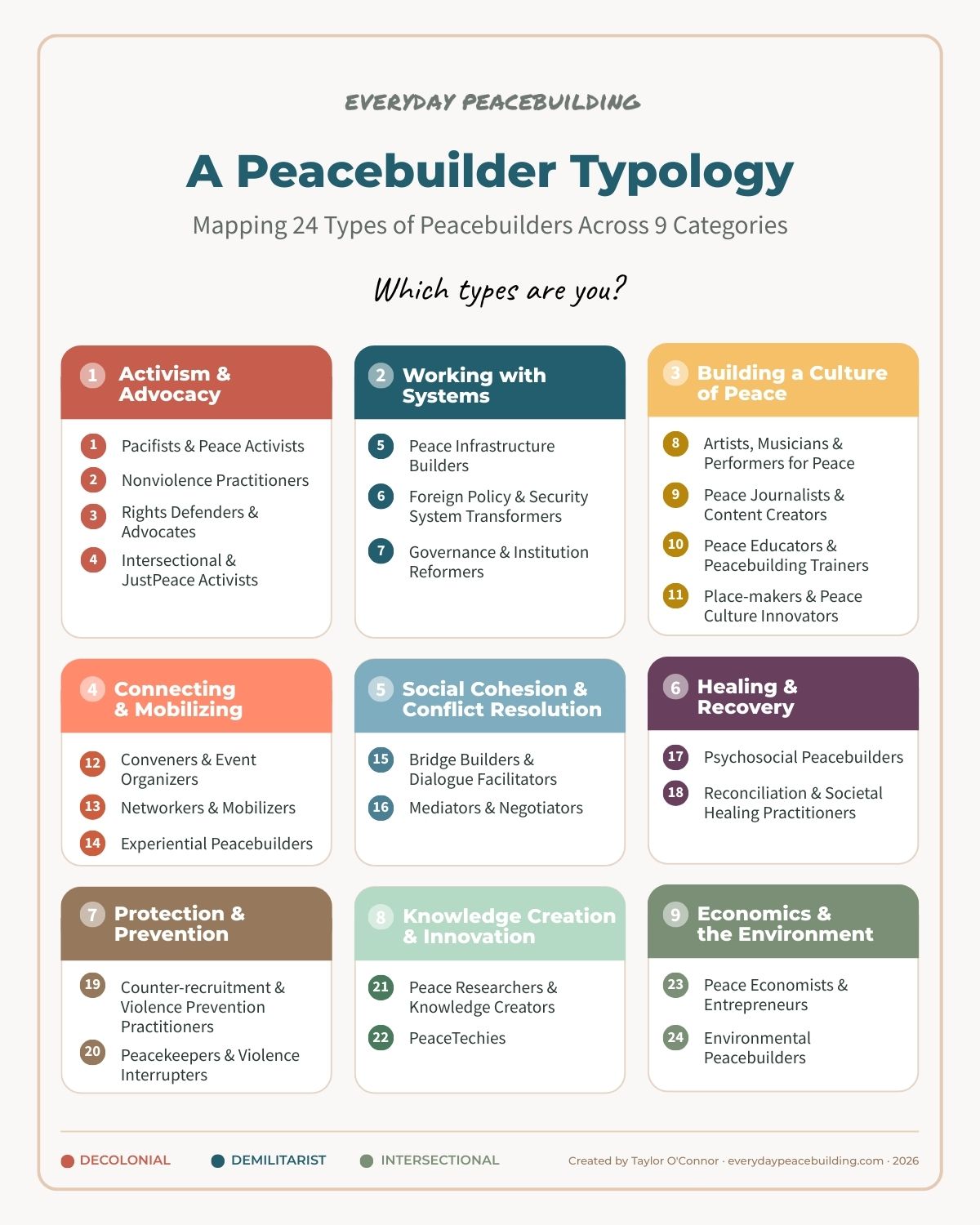
The Peacebuilder Typology
Discover the full scope of what peacebuilding can be.
Most peace and conflict studies programs, and most peacebuilding training, cover a narrow range of approaches: mediation, dialogue, social cohesion, and perhaps a few specialized areas like international law or gender and peacebuilding. Our Peacebuilder Typology changes that completely.
The Typology maps hundreds of ways to build peace, organized into 24 types of peacebuilders across 9 categories. Drawing from over a decade of Taylor's research on peacebuilding practice, a database of 5,000+ peace organizations worldwide, and insights from 800+ community surveys across 100+ countries, it is the most comprehensive mapping of peacebuilding practice available anywhere.
In this course, you'll work through a structured self-assessment to identify your top 3 peacebuilder types and discover your peacebuilding superpower, the unique combination of skills and abilities that defines how you can make the greatest impact for peace.
Entire domains of peacebuilding most people have never encountered: peace economics, PeaceTech, peace anthropology, arts-based peacebuilding, environmental peacebuilding, peace tourism, peace journalism, peace psychology, peace parks, peace museums, and many more. Students consistently say the same thing when they work through the Typology: "I had no idea this existed."
The result is twofold: you can bring new approaches into the work you're already doing, and you can explore entirely new career paths and life trajectories for building peace that you never knew existed.
What you'll walk away with:
An understanding of the peacebuilding sector and the ecosystems where people build peace. You'll gain a clear understanding of how the peacebuilding sector works, from international peace architecture to local peace systems and grassroots movements, including the ecosystems and dynamics amongst peace actors that shape diverse peace efforts. You'll learn how to navigate these systems, leverage linkages across peacebuilding ecosystems, and build peace both inside and outside of them.
An introduction to the frontiers of peacebuilding. An exploration of the key movements and frontiers shaping the future of peacebuilding, including PeaceTech, Peace Economics, Environmental Peacebuilding, and Peace Science, among others. You'll see where the field is headed, where there is space for innovation, and where the opportunities to expand the boundaries of peacebuilding lie.
Your peacebuilding superpower. Through EP's Peacebuilder Typology, you'll identify your top 3 peacebuilder types and discover what we like to call your peacebuilding superpower, the combination of your unique skills and abilities that informs how you can make the greatest impact for peace.
A Personal Peacebuilding Roadmap. By the end of the course, you'll produce a concrete document mapping your peacebuilding journey: your peacebuilder superpower profile, the organizations, networks, and resources connected to your top peacebuilder types, practical ways to integrate new approaches into your current work or pursue new paths, and a plan for the coming months and year. This is not a theoretical exercise. It's a usable document you'll return to and a guide for your peacebuilding journey.
Who this course is for:
Peacebuilding, humanitarian, and development professionals who can see the limitations of conventional approaches to building peace and want original frameworks, tools, and a broader understanding of what peacebuilding can be to help you find creative ways to build peace in your work.
Professionals in related fields (social justice, human rights, education, governance, environmental work) who want to integrate peacebuilding into your work with confidence and with creative approaches that go far beyond what standard trainings may offer.
Graduate students and recent graduates in peace studies or related fields who want to bridge the gap between academic theory and practical application, discover a wide array of career paths your program never mentioned, and stand out in a competitive and shrinking job market.
Anyone entering the peacebuilding field or getting started in peace work who wants a comprehensive foundation in peacebuilding built on original research and practical tools, without needing a graduate degree or years of institutional experience to get started.
Experienced practitioners looking for fresh perspectives. If you've worked in peacebuilding for years but feel constrained by the limitations of conventional systems, this course offers new frameworks, new approaches, and an expanded view of what's possible for your career and your impact.
Note: The curriculum shown below reflects updates we are making for our 2026 course relaunch. New modules are released one per week over six weeks, beginning July 2.
Course Outline
- Lesson 1: How Peace Histories Inform Peace Practice (16:23)
- Lesson 2: Recognizing the Worldview that Drives Conventional Peacebuilding (14:50)
- Lesson 3: Peacebuilding as Societal Transformation (16:10)
- Lesson 4: Peacebuilding & War Abolition (20:34)
- Lesson 5: Peacebuilding & Decolonization (21:13)
- Lesson 6: Peacebuilding, Social Justice & Intersectionality (24:13)
- Lesson 7. Redefining Peacebuilding (16:01)
- Lesson 1: Understanding Peacebuilding Systems & Structures (24:50)
- Lesson 2: Recognizing a Diversity of Spaces Where People Build Peace (18:23)
- Lesson 3: Jobs in Peace - Peace in Jobs (23:25)
- Lesson 4: Building Peace & Making Change Within Systems (19:46)
- Lesson 5: Building Peace Outside of Traditional Systems (15:32)
- WATCH FIRST: Your Peacebuilder Typology Self-assessment (18:11)
- Lesson 1: Activism & Advocacy (types 1 - 4)
- Lesson 2: Working with Systems (types 5 - 7)
- Lesson 3: Building a Culture of Peace (types 8 - 11)
- Lesson 4: Connecting & Mobilizing (types 12 - 14)
- Lesson 5: Social Cohesion & Conflict Resolution (types 15 - 16)
- Lesson 6: Healing & Recovery (types 17 - 18)
- Lesson 7: Protection & Prevention (types 19 - 20)
- Lesson 8: Knowledge Creation & Peacebuilding Innovation (types 21 - 22)
- Lesson 9: Economics & the Environment (types 23 - 24)
Pricing and enrollment details are at the bottom of this page ↓
Course Facilitator
Taylor O’Connor, founder of Everyday Peacebuilding
I'm Taylor, a big peace nerd at heart, long obsessed with exploring creative ways people build peace around the world. I got my Master's in Peace Education from the UN-Mandated University for Peace back in 2009, and I've worked as a peacebuilding specialist with NGOs and UN agencies in many countries since that time.
Driven by a curiosity about all the ways people build peace inside and outside of traditional systems, I began researching and mapping peacebuilding practice worldwide. After a decade of research, I built a database of 5,000+ peace organizations and collected data from 800+ community members around the world.
That research informed the creation of the Peacebuilder Typology, a framework mapping hundreds of ways to build peace organized across 24 distinct types of peacebuilders. It is the most comprehensive mapping of peacebuilding practice available anywhere. From this framework and research background, I've also developed a range of other original tools to help people from all walks of life find creative and effective ways to build peace.
I created Everyday Peacebuilding because I believe peace is built in a wide variety of ways, often by people who don't have fancy degrees and who operate outside traditional systems. Anyone can build peace. They just need to learn about the many diverse ways to build peace, get access to practical tools, and be part of a supportive community. Whether you're entering the field for the first time or you've been doing this work for decades, we are pleased for you to join our learning community. I hope to see you inside.

What peacebuilders say about our courses...

"This course is very important to upgrade my knowledge about peacebuilding. After surviving the genocide in Tigray, I wanted to learn how to build peace in my community. The Foundations course helped me understand about positive peace versus negative peace, and how to teach these concepts to others.
The information about peacebuilding partnerships between international and local organizations was very useful to me. Through this course, I learned about International Cities of Peace and successfully registered Mekelle City, the capital of Tigray, as a member. I am now using sport activities for peace, reconciliation and healing in my community.
The language used in the training videos was clear to understand even though English is my second language. I am happy to recommend this course to anyone who wants to promote peace in their community."
- Gebreegziabher Tadele, community peacebuilder from Tigray, Ethiopia
"After more than 30 years of working in the peace research field, the course gave me the space I needed to redirect my energies in new directions, and to find clear pathways in a world that is changing fast. This course is user-friendly and provides all the tools you need to make a change on any social issue you care about. I highly recommend this eCourse to anyone who cares about making our world a better place, or more realistically, making a tiny part of the world just a little bit more humane, and who wishes to do so with effective tools."
- Dr. Olivier Urbain, Director of the Min-On Music Research Institute, Adjunct Faculty at the Soka University Graduate School of International Peace Studies
Pricing and Enrollment
We are committed to making our courses accessible to people from all walks of life working for peace around the world, and our pricing system reflects that.
Every course is offered at three rates, and you choose the one that fits. You know your financial reality. There's no application process, no verification, and nothing to justify. Just pick your rate and enroll.
Everyone who enrolls gets the exact same complete course, whichever rate you choose: all modules, the optional live virtual cohort once a year, and lifetime access to materials and updates. The rate you pick changes nothing about what you receive. And if you choose the Standard Rate, you're also sustaining our full scholarship program for peacebuilders who cannot pay at all.
Standard Rate — $350
For those with stable income or organizational support. This rate sustains the full scholarship program.
Community Rate — $250
For those with moderate or variable income.
Global Access Rate — $150
For those working in low-resource contexts or with limited income.
Choose the rate that fits your financial reality. We trust you.
For organizations: Looking to enroll staff members as part of professional development? Email Taylor for organizational pricing and group enrollment options: taylor@everydaypeacebuilding.com
Want to use your organization's professional development budget? Forward this page to your supervisor. Many organizations recognize our courses as professional development that directly improves effectiveness of peace initiatives.
Alternative payment methods available: If you need to pay via bank transfer, Wise, mobile money, M-Pesa, or in local currencies, email our community manager Mustapha at mustapha@everydaypeacebuilding.com who can help find a solution that works for you.
Our Scholarship Program
Everyday Peacebuilding is a community of peacebuilders from all walks of life in over 100 countries. We believe peacebuilding education should be accessible to everyone, regardless of financial circumstances.
Diverse participation strengthens our community and enriches the learning experience for everyone. When peacebuilders from different contexts, backgrounds, and experiences learn together, we all benefit.
Full scholarships are available based on financial need. Applications are open year-round and reviewed on a rolling basis by Mustapha, our community manager. During promotion of yearly live cohorts we review applications on a rolling basis.
Questions?
Course questions: taylor@everydaypeacebuilding.com
Scholarship and alternative payment questions: mustapha@everydaypeacebuilding.com